|
| |
Return to Ecosystem Weight
Management
Socio-Ecological
Model--Looking Beyond the Individual
What are ALL the
Factors That Influence Your Weight? Is It JUST You?
The World We Live
In Influences Us.
-
The
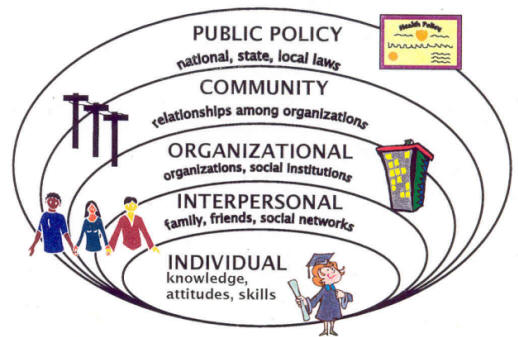
socio-ecological model recognizes the interwoven relationship that exists
between the individual and their environment.
-
While individuals
are responsible for instituting and maintaining the lifestyle changes
necessary to reduce risk and improve health, individual behavior is
determined to a large extent by social environment, e.g. community norms and
values, regulations, and policies.
-
Barriers to
healthy behaviors are shared among the community as a whole. As these
barriers are lowered or removed, behavior change becomes more achievable and
sustainable. It becomes easier to "push the ball up the hill."
-
The most effective
approach leading to healthy behaviors is a combination of the efforts at all
levels--individual, interpersonal, organizational, community, and public
policy.
Taken from Jane Moore,
Ph.D., RD Manager of Oregon Department of Human Services-Health Services
Used with permission.
Many factors contribute to
chronic diseases. Some of these factors are modifiable behaviors; in
other words, they reflect individual health behaviors. Half of all
deaths Oregon can be attributed to unhealthy lifestyle or modifiable
behaviors like tobacco use, sedentary lifestyle, poor diet, and not
getting preventive screenings like mammograms or blood cholesterol
tests.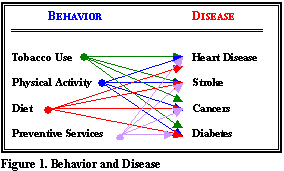 Many of these health behaviors are risks for several chronic diseases
(see Figure 1).
Many of these health behaviors are risks for several chronic diseases
(see Figure 1).
By altering lifestyle
behaviors, the risk of developing heart disease, stroke, cancer, and
diabetes for Oregonians can be reduced.
Communities, schools,
worksites and healthcare sites can support and promote healthy behaviors
through policies and environmental factors such as smoke-free
workplaces, healthy cafeteria meals, sidewalks & bike paths, incentives
for bicycle and pedestrian commuters, worksite wellness programs,
insurance coverage for preventive services such as mammography and
tobacco cessation. |
Healthy Active Oregon 2003
What Can You Do?
Small Steps Can Make A Big Difference
Individuals
-
Eat reasonable food and beverage portion sizes at home and when
eating out.
-
Eat 5 to 9 fruits and vegetables each day, or more!
Visit the
https://www.fruitsandveggiesmorematters.org/
Web site to get tools and
information to help you eat more fruits and vegetables each day!
Fruits and Veggies Help You Manage
Weight.pdf
-
Walk or bicycle more often -- to work or school, for errands, to
visit friends, just for the
fun of it.
-
Be a better driver – obey the speed limit, stop for pedestrians
crossing the street, watch
out for bicyclists.
Parents
-
Serve as good role models by practicing healthy eating habits and by
being physical
active every day.
-
Make sure tasty, attractive fruits and vegetables are available for
meals and snacks
at home and when eating out.
-
Set limits on television viewing.
-
Limit access to sugar-sweetened drinks.
-
Work with your children’s schools to develop policies regarding:
vending
machines, use of foods as rewards in classrooms, adequate lunch and recess time, daily
PE, safe walking and bicycling routes to school.
-
Organize Walk to School Day events in your children’s schools.
-
Breastfeed your infant for at least one year.
Employers
-
Offer walk/bike/transit incentives like bicycle parking and transit
passes.
-
Provide exercise and changing facilities at work.
-
Post signs near elevators encouraging people to take the stairs.
-
Make the stairway a safe and inviting place.
-
Support community-wide events that promote physical activity.
-
Set standards for foods served at cafeterias, in vending machines,
and at meetings.
-
Use price incentives in the cafeteria and in vending machines to
increase
consumption of healthy foods.
-
Promote 5 A Day at your worksite.
-
Add more water drinking fountains.
-
Create a worksite environment supportive of breastfeeding.
Community Member
-
Participate in neighborhood, community, and transportation planning
groups.
-
Support funding for sidewalks, bicycle paths, parks, recreation
centers, and swimming
pools.
-
Declare and organize an annual National “No-TV” Week.
-
Join or start a walking or bicycling group in your neighborhood.
-
Organize a Farmers’ Market in your neighborhood or community.
-
Support policies to promote healthy eating such as disclosing the
calorie content of
restaurant food and requiring calorie labeling on menus and menu boards at chain
restaurants.
-
Join advocacy groups promoting community design supportive of safe
and
accessible walking and bicycling.
-
Let your community leaders and elected officials know that you
support healthy, active
communities.
Architects, Community and Transportation Planners
-
Design buildings where stairs are visible, accessible and safe.
-
Adjacent to buildings, provide sidewalks, convenient bicycle parking
and safe
connectivity to public transit.
-
Consider public transit, sidewalks, bicycle lanes, and bicycle paths
for walking and
bicycling to be as essential as streets and roads for vehicles.
-
Design frequent and safe street crossings.
-
Design neighborhoods and communities where children and adults can
easily and safely
travel between home, work, school, retail establishments, parks and
recreation facilities on foot and bicycle.
Community Leaders and Policy Makers
-
Consider health consequences along with financial impact when
developing school
policies such as contracts with soft-drink companies, offering daily PE,
promoting walking and bicycling to school, or district support for school meal
programs.
-
Prioritize funding for increasing and improving pedestrian and
bicycle facilities in communities.
-
Consider public health impacts in land-use planning decisions such as
siting of schools,
development of mixed-use neighborhoods, and location of farms
producing fruits and vegetables near urban areas.
-
Consider zoning regulations that allow more Farmers’ Markets in
neighborhoods.
-
Assure access to full-service grocery stores in all neighborhoods and
limit density of fast
food restaurants.
-
Prioritize funding for effective public health interventions to
increase physical activity,
promote healthy eating, and reduce obesity and chronic diseases.
“Many people
believe that overweight and obesity is a personal responsibility. To some
degree they
are right, but it is also a community responsibility. When there are no safe,
accessible
places for children to play or adults to walk, jog, or ride a bike, that is a
community
responsibility. When school lunchrooms and office cafeterias do not provide
healthy and
appealing food choices, that is a community responsibility. When new or
expectant
mothers are not educated about the benefits of breastfeeds, that is a community
responsibility. When we do not require daily physical education in our schools,
that is
also a
community responsibility. There is much that we can and should do together.”
–
David Satcher,
The Surgeon General’s Call to Action to Prevent and Decrease
Overweight and
Obesity,” 2001.
Socio-Ecological
Model. Definitions:
The-socio-ecological-model definitions.pdf
The
Social-Ecological Model: A Framework for
Prevention for Individual and Social
Violence
 The
ultimate goal is to stop violence before
it begins. Prevention requires
understanding the factors that influence
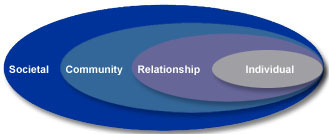
violence. CDC uses a four-level
social-ecological model to better
understand violence and the effect of
potential prevention strategies
(Dahlberg & Krug 2002). This model
considers the complex interplay between
individual, relationship, community, and
societal factors. It allows us to
address the factors that put people at
risk for experiencing or perpetrating
violence. The
ultimate goal is to stop violence before
it begins. Prevention requires
understanding the factors that influence
violence. CDC uses a four-level
social-ecological model to better
understand violence and the effect of
potential prevention strategies
(Dahlberg & Krug 2002). This model
considers the complex interplay between
individual, relationship, community, and
societal factors. It allows us to
address the factors that put people at
risk for experiencing or perpetrating
violence.
Prevention strategies should include a
continuum of activities that address
multiple levels of the model. These
activities should be developmentally
appropriate and conducted across the
lifespan. This approach is more likely
to sustain prevention efforts over time
than any single intervention.
Individual
The first level identifies biological
and personal history factors that
increase the likelihood of becoming a
victim or perpetrator of violence. Some
of these factors are age, education,
income, substance use, or history of
abuse. Prevention strategies at this
level are often designed to promote
attitudes, beliefs, and behaviors that
ultimately prevent violence. Specific
approaches may include education and
life skills training.
Relationship
The second level examines close
relationships that may increase the risk
of experiencing violence as a victim or
perpetrator. A person's closest social
circle-peers, partners and family
members-influences their behavior and
contributes to their range of
experience. Prevention strategies at
this level may include mentoring and
peer programs designed to reduce
conflict, foster problem solving skills,
and promote healthy relationships.
Community
The third level explores the settings,
such as schools, workplaces, and
neighborhoods, in which social
relationships occur and seeks to
identify the characteristics of these
settings that are associated with
becoming victims or perpetrators of
violence. Prevention strategies at this
level are typically designed to impact
the climate, processes, and policies in
a given system. Social norm and social
marketing campaigns are often used to
foster community climates that promote
healthy relationships.
Societal
The fourth level looks at the broad
societal factors that help create a
climate in which violence is encouraged
or inhibited. These factors include
social and cultural norms. Other large
societal factors include the health,
economic, educational and social
policies that help to maintain economic
or social inequalities between groups in
society.
Reference
Dahlberg LL, Krug EG. Violence-a global
public health problem. In: Krug E,
Dahlberg LL, Mercy JA, Zwi AB, Lozano R,
eds. World Report on Violence and
Health. Geneva, Switzerland: World
Health Organization; 2002:1–56.
-
The
Social
Ecology
Model,
also called
Social
Ecological Perspective, is a
framework to examine the multiple
effects and interrelatedness of
social
elements
To investigate
an amazing compilation of factors that lead to overweight in the world, check
out:
http://www.shiftn.com/obesity/Full-Map.html
www.walkinginfo.org
The Pedestrian and Bicycle information Center (CDC) serves anyone interested
in pedestrian and bicycle issues through its Web site. This informative site
encourages citizens to get involved in city planning to promote safer, more
walkable cities. Included are a "community toolbox," a set of techniques for
project development and community participation, and a walkability checklist to
help determine a community's walking potential.
http://www.activelivingbydesign.org/
Active Living by Design is a
national program of the Robert Wood Johnson Foundation and is a part of the UNC
School of Public Health in Chapel Hill, North Carolina. This program establishes
innovative approaches to increase physical activity, healthful eating,
through community design, public policies and communications strategies.
Explore
Active Living Essentials
Healthy Eating by Design PDF
Walk around
Small Baby Steps Lead to Success!
for additional ideas.
|