|
If we're
not careful,
We will
wind up where we are headed. --Chinese Proverb
Your moment-by-moment
choices up until now have shaped your present life.
What You Plant Is What You Get.pdf

Change? Who, Me? How?
If You Continue To Do
What You’ve Always Done,
You’ll Continue To Get
What You’ve Always Gotten!
How is your life going? Is it going well?
Do you feel overwhelmed and confused?
Are your behaviors around food out of control?
Are you fairly miserable? Do you feel helpless and hopeless?
If you are uncomfortable, this could lead you to consider making changes. Pay a
visit to Bob's Story
(physical activity example) and look below for an explanation of the Stages
Of Change Model which describes the process of making changes.
However you feel,
just start where you are! You can't be anywhere else.
Ecosystem Weight Management is a process…of AWARENESS,
SELF-HONORING,
ACTION, and SUPPORT...that encourages gradual change.
You may find that
your life at present is touched by many
challenging circumstances that
make losing weight seem impossible. You might feel helpless and hopeless about
changing. Is this how you are feeling? I have
felt that same way before.
Things CAN change for the better.
Consider exploring
the
Do You
Experience Overwhelming Circumstances?
link to provide perspective and to
get encouragement for yourself.
Achieving a healthier
weight for a
lifetime
requires lifestyle adjustment and lots of practice!
If you keep on with
The SAME
commitments,
THE SAME relationships,
THE
SAME thought patterns,
THE SAME food plan,
THE SAME ways of nurturing yourself,
Well, guess what?
You’ll get the same...RESULTS!
The key is to simplify your life…to S...L...O...W...IT DOWN!
Look into your life and ask yourself:
In WHAT ways is your life working
well? Pay attention.
Acknowledge yourself!
HOW is it not
working well? Where do your
daily choices lead you? Towards well-being? Towards disease?
HOW do you do you do this to yourself? Consider paying attention. Be tender with
yourself.
Observe yourself with gentleness,
honesty and self-respect.
WHAT is it that YOU DO (or don’t do) to create the out-of-control
patterns?
When things go well, WHAT ARE YOU DOING (or not doing) to support this?
HOW can you transform your daily
choices to bring you lasting health?
See
Bob’s story and other sections
of this Web site.
Cultivate what is
wholesome. Abandon what is harmful. Over time, unwholesome patterns get weaker
and the new, wholesome patterns take their place and become stronger.


How do you begin? Where do
you begin? Right where you are.
You can’t be anywhere else. So, start there.
Seize the Moment!
See your unborn wholeness and trust for it to emerge. Visit
the
Essential Skills section
#9 for
Self-Nurturing
ideas.
Remember: Progress, not perfection!
Developing new patterns is an unfolding process...it blossoms...gradually…
One day at a time!
Are you ready for the adventure? Let’s begin!
Small enjoyable changes,
consistently practiced, lead to sought-after results!
The steps that you
select should be FUN
and enjoyable! Self-care does not have to
be torture. You can learn to celebrate a healthful
lifestyle! In fact,
making FUN your focus will insure that your new patterns naturally become your
new way you create your life.
Pay a visit to
Small Baby Steps
Lead to Success!
The
thinking that caused the problem cannot be the thinking that solves it. --Albert
Einstein
Problems
cannot be solved at the same level of awareness that created them.
Choose
to THINK and DO something different!
It's All About You....

IT’S ALL ABOUT YOU….
Make healthy choices that fit your lifestyle so you can do the
things you want to do.
Be realistic: make small changes over time in what you eat and the level
of activity you do.
BE ADVENTUROUS: Expand your tastes to enjoy a variety of foods.
BE FLEXIBLE: Balance what you eat and the physical activity you do over
several days. No need to worry about just one meal or one day.
BE SENSIBLE: Enjoy all foods, just don’t overdo it.
BE ACTIVE: Walk the dog, don’t just watch the dog walk!
LEARNING FROM SETBACKS:
-
REFRAME SETBACKS: The difference between
perfectionism and excellence is that PERFECTIONISM forbids mistakes;
EXCELLENCE learns from mistakes and makes corrections! Perseverance is the
most important.
-
Notice what you are doing right (which is probably
most things). Celebrate your successes--no matter how small they seem to be.
-
Emphasize patience. We are just learning a new
behavior or skill. Celebrate the failure of not meeting your goals. We learn
more from “setbacks” than success!
-
Invent NEW MISTAKES! Don’t fear them.
-
Humans are a part of nature. We change in the same way—back
and forth-between old and new—towards a new experience.
Engender a sense of tolerance.
There are many paths to well-being.
Use what works. Release what doesn't.
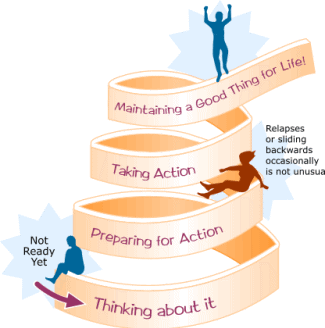
The Stages of Change:
No one
stage is more important than another—it’s a PROCESS of change.
*
* Taken
from the CDC Physical Activity is for Everyone:
http://www.cdc.gov/nccdphp/dnpa/physical/starting/
The Stages
of Change:
No one stage is more important than
another—it’s a process.
Stage of Change
|
Ways to Motivate Change
|
|
Pre-contemplation—Not
even thinking about changing.
Not ready
yet! |
Increase awareness of the effects of the problem behavior.
HOW are your present choices harmful to you or others? Take
responsibility. |
|
Contemplation—Beginning
to think about risks and benefits of change.
Contemplate &
Prioritize!
|
Many people experience a "triggering event":
illness, mental or emotional distress. The
goal is to decrease uncertainty about wanting to make changes by
identifying pros (benefits to you) and cons (hassles) of change.
Are the long-term benefits
worth the short-term costs?
What Does It Look Like When Things Are Going Well?
These
times can be filled with guilt, shame, hopelessness, and desperation.
See ideas below on how to sort things out. Get support for yourself. |
|
Preparation—Plan
for a change, but you don’t know what to do. You begin to think of ways to change.
Plan &
Prepare—gather tools for yourself! |
Evaluate your life, get
advice and help. Seek information:
perhaps make phone calls, attend
meetings or seminars.
You're in the process of gathering tools for
yourself. Listen to your "self-talk" about the value to you of making
changes.
Make an action plan with specific steps. Set a date.
Identify rewards. |
|
Action—Making
changes. Committing time and energy to practice new behaviors.
Action =
Practice! |
Start small. Set
specific, achievable, meaningful, short-term goals. Work to solve problems as they arise.
Action
is PRACTICE. New behaviors will feel uncomfortable to you at first, and you won't
be very skilled at them. You'll make mistakes. New habits are the most
"fragile" to revert back to OLD habits during the first 6 months. |
|
Relapse—Returning
to former patterns. It will happen. Choose to learn from it. Can
last five minutes or five years!
Apply
Positive & Powerful Problem Solving! Learn to cope.
|
RELAPSE IS NOT FAILURE. IT IS LEARNING.
It can happen at ANY stage, especially between pre-contemplation and
contemplation, and during times of crisis.
Be kind with yourself and honest. NOTICE
what has happened. Determine what you can learn from the
experience, and plan ahead for the future. Problem
solve:
use your knowledge as a tool for your next stage. Keep a journal to notice and
unravel patterns. Plan behavior substitutions.
Don’t give up. Don't give up. Just begin again!
Seek out helpful
resources on this web site. |
|
Maintenance—Continuing
new behaviors with increased confidence. Have awareness of what triggers
a relapse and make plans to avoid it.
Persist with
Patience and have FUN! |
Remind yourself of reasons for having
changed--never forget WHY you wanted to do something different.
See Bob's story,
Emotional Area for examples of reasons.
Reevaluate and redefine your tools and your plan.
It will get easier to maintain new behaviors over time. Be patient and persistent.
Change is a process, NOT an event. Practice self
and stress-management skills.
Notice if you have fallen back into a chronic,
unhealthy patterns again and use the self-evaluation tools (use the
Daily Personal
Check-In section of this Website).
Congratulate yourself for having the courage to do it! |
For a PDF
printable file:
The Stages of Change-WEBSITE 2.pdf
Are you "sick and tired of
being sick and tired?"
Create an inspiring reason for your commitment! Perhaps get a notebook and write
down the answers to these questions:
-
How would you define success for
yourself? What do you want to do or change in your life? How would it
benefit you (or others) to do it?
-
List some advantages and
disadvantages of keeping things the way they are or doing things
differently:
ASK Yourself:
I encourage you to take the time to write down the answers to these
questions and consider them for yourself.
After you go through this "sorting out" process, you will have convinced
yourself of the value TO YOU of choosing to make an investment in yourself
to change your life.
To USE the stages of change process to help you make
changes, explore:
A Daily
Reminder
Change your moment-by-moment choices, change your
life!
Pay attention!
Live in AWARENESS, not just on autopilot.
Notice your
PATTERNS. WHO is going to live your life?
YOU or your
patterns?
See
Reasons
We Eat: Healthful and Harmful section.
Some daily reminders for
making an effort—by reflecting, reading, studying, trying new things out each
week. So in effect, set your
motivation—your reason for making the effort.
For most people the process of
making lasting lifestyle changes takes 1 - 3 years.
Be an explorer…
Have fun!
-
Think
about why you are making an investment in yourself.
-
Are you perhaps sick and tired of feeling
sick and tired?
-
Are you ready to quit fad dieting and
ready to make a long-term investment, a commitment—in you?
-
Do it—because you deeply care about you.
-
Do it—because you want your life to be
healthy at all levels: in body, mind, and spirit.
-
I make a commitment to be open to learning!
-
I make a commitment to be aware of my
choices and their consequences!
-
I
make a commitment to be kind to myself!
-
I
make a commitment to a new way of living!
-
I make a commitment to celebrate life-long
learning!
Aspirations:

May I trust my limitless ability to grow and may I respect
the progress I’ve already made.
Become who
I truly want to become. Trust that I can do it!
 I
love who I am and I love who I am becoming. I
love who I am and I love who I am becoming.
Unlock your
potential!
Say YES to your wild & precious life!

You have
within you
All the
answers to the challenges you face.
Become your
own personal lifestyle trainer
Or in
effect, be a gardener to your own mind and life.
Have a deep
confidence in your ability to heal suffering
and a deep
belief in your magnificent potential.
Tune within for your answers.
As you
practice this skill, over time,
You discover
your profound wisdom.
Step-by-step
You become healthier from the inside
out.
RESOURCES
Making a Change for Good: A Guide to Compassionate Self-Discipline
(Paperback) by Cheri Huber (Author)
This is a wonderful book.
Please visit Cheri's own website for access to her many other wonderful books:
http://www.cherihuber.com/
Additional
Resources for
Self-Change
·
Changing for Good: A
Six-Stage Program for Overcoming Bad Habits and Moving Your Life Positively
Forward by James Prochaska,
John Norcross, Carlo Diclemente. (1994). Avon Books.
·
The 7 Habits of Highly
Effective People, by Stephen R.
Covey. (1989). Simon & Schuster and First Things First by Stephen
R. Covey and A. Roger Merrill. (1994). A Fireside Book. Both are classics!
Return to Top
|